
Evening Walk in Tervuren Park

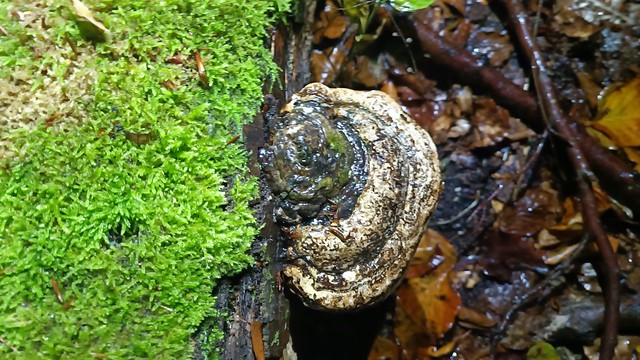
3 October 2025 · Tervuren Park, Belgium
This walk was hosted by the Griffin Scout Troop. I'm grateful for their warm welcome and their curiosity throughout the evening.
Almanac · Walk Report
Early October greeted us with light rain, cool air (11°C), and the quiet feeling that autumn had truly arrived.
I had been invited by a fellow immigrant to guide an evening nature walk in English for her Scout troop. It was a wonderful opportunity to share two tools I often recommend to beginners—ObsIdentify for plants and fungi, and Merlin for bird sounds—but even more importantly, to introduce a way of experiencing nature based on curiosity, attention, and kinship.
Rather than covering a great distance, we wandered slowly through a small part of the park, letting our observations guide the route.
What caught our attention
🌰 A forest preparing for winter
The paths were scattered with acorns, beech nuts, sweet chestnuts, and horse chestnuts. It was clearly a mast year, with trees producing an exceptional abundance of seeds.
We talked about why trees sometimes synchronize these bumper crops and how such years ripple through the ecosystem, feeding everything from mice to jays. One of the adult leaders wondered aloud whether longer natural cycles might also play a role—a fascinating question I'll have to explore another day.
🐦 Evening settles over the park
As dusk approached, a large flock of carrion crows gathered for their evening roost, their calls echoing across the ponds.
We also heard coots, mallards and great crested grebes, while frogs and a single common toad (Bufo bufo)appeared among the reeds.
One scout gently picked up the toad, who simply settled into her warm hands without struggling.
That quiet moment stayed with me.
Children rarely need to be convinced that they belong to nature. Often, they only need the opportunity to experience that belonging.
🍄 Life after the rain
Bracket fungi stood out brightly against damp trunks and fallen wood. We noticed species including Trametes gibbosa, Fomes fomentarius, and a few honey fungi (Armillaria).
I'm still very much learning fungi, but I love how impossible they become to overlook once you begin paying attention.
🌙 Darkness as a teacher
One unexpected delight came as daylight faded.
Instead of immediately switching on their torches, many of the scouts allowed their eyes to adjust naturally.
The darkness slowed us down.
We noticed the scent of flowering ivy, the sound of rain on leaves, and the movement of wind through long grass in a way we might otherwise have missed.
Looking back
I almost cancelled this walk.
An ear infection had left me wondering whether an evening in the rain was really a sensible idea.
I'm very glad I went.
The warmth and curiosity of the group reminded me why I enjoy guiding. More importantly, it gave me the opportunity to speak about something that has become central to my own relationship with the natural world.
We often talk about connecting with nature, as though the work belongs entirely to us.
That evening, watching a child quietly holding a toad that had chosen to remain perfectly still, I was reminded that perhaps connection is less about reaching out and more about becoming still enough to let the natural world reach back.
📝 Field Record
Date: 3 October 2025
Location: Tervuren Park
Species recorded: 6
Observations submitted to: Observation.org
The observations recorded during this walk are available as a downloadable species list.
Download the complete field record (CSV)
Continue Exploring
📍 Place: Tervuren Park (coming soon)
🚶 Activity: Nature Journaling (coming soon)
🌿 Field Note: Common Toad
📚 Related Resource: The Evolved Nest
🌱 Further Exploration
If you’d like to learn more about what we discussed:
- What Is a Mast Year? – Woodland Trust, 2025
Learn why some years produce more tree seeds than others, and how this affects wildlife populations. - How to Identify Nuts and Seeds – Discovering Belgium, 2022
A practical guide to recognizing common nuts and seeds you might find on walks. - Hedgerow Berries & Seeds & Nuts ID Guide (Bundle) – Discovering Belgium Shop, 2025
Printable resources for identifying a wide range of hedgerow fruits and tree seeds. - The Bristle Head Crows – Gomez, 2016
Fascinating observations of crow behavior, including evening roosts. - What Is the Difference Between a Frog and a Toad? – Woodland Trust, 2024
Clear explanations of physical and behavioral differences between frogs and toads. - Field Guide to the Amphibians and Reptiles of Britain and Europe – Speybroek et al., 2016
Comprehensive PDF guide covering European frogs, toads, lizards, and snakes. - What the Ghost Pipes Said: Healing Our Kinship Blindness – Kindred Media, Regan, 2025
Explores a kinship perspective on nature and our connection to the living world. - Petrichor: What Causes the Earthy Smell After Rain? – Whitbourne & Bowie, 2025
Science behind that wonderful earthy scent that comes after a rainfall.
You should also read:
Walking at a Child's Pace
One of my favourite questions I've ever been asked on a nature walk came from a small voice holding my hand. "Are there fairies in this forest?" I smiled—not because I knew the answer, but because I realized the question itself was a gift. Children…
Continue reading...